
Learn tarot
Pull up a chair. This is where I keep what the cards mean to me, so you can sit with one whenever you need to.
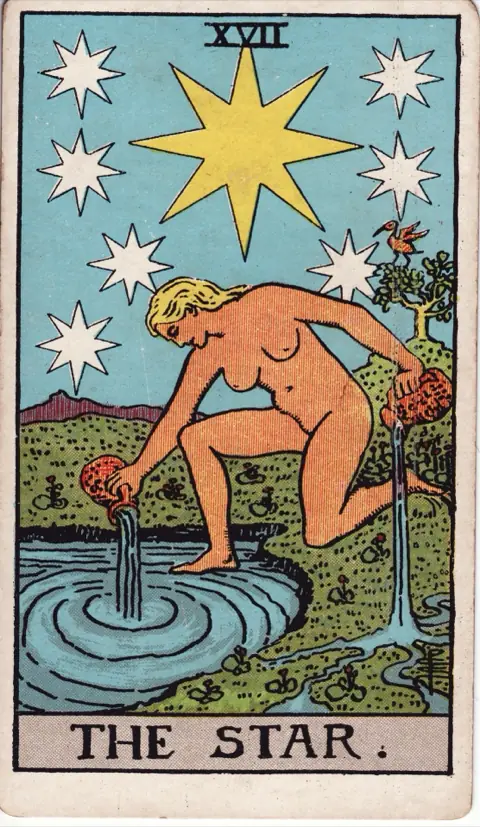
I read the Rider-Waite-Smith deck, the 1909 one. The 22 Major Arcana carry my own notes on each card. The other 56 were written in my voice from their traditional meanings, until I've written mine.
- The 78 cardsEvery card, upright and reversed, in love and in work, with its yes-or-no lean.
- Today's cardOne card for everyone, drawn fresh each morning.
- How the Oracle readsThe server shuffles, you choose your cards, and they're fixed before a word is written. What it is, and what it will never do.
- Daily horoscopeAll twelve signs, written each morning from that day's sky by the Oracle, Rosemary's AI.
How to read tarot
A short guide, written by the team that builds this site from the traditional way the cards are read.
How a reading works
A reading starts with a question, or with none at all. The deck is shuffled, a few cards are drawn, and each one is read for the place it lands in, called its position. One card answers one question. More cards show more of the picture around it.
The cards don't decide anything for you. They show where things stand and which way they are moving, and what you do with that stays yours. Rosemary puts it in one line: "I read the energy, not the future."
Major and Minor Arcana
A tarot deck has 78 cards. The 22 Major Arcana run from The Fool, numbered 0, to The World, XXI. They are the big turns in a life: beginnings, endings, a reckoning, a fresh start. When several come up in one reading, the question is a large one.
The 56 Minor Arcana are the everyday. There are four suits of fourteen cards, Ace to Ten, then Page, Knight, Queen and King. Cups are water: feelings, love and friendship. Pentacles are earth: money, work, home and the body. Swords are air: thoughts, words, conflict and the truth. Wands are fire: drive, ideas and what you want.
Reversed cards
A card that turns up upside down is reversed. Most readers take it as the same energy as the upright card, only blocked, delayed, turned inward or being resisted. A hard card reversed can mean the worst of it is easing. Some readers leave reversals out altogether, and the Oracle lets you switch them off.
Three spreads
One card. One question, one card. It suits a yes-or-no question and a card for the day.
Three cards. Past, present and future: what has been shaping the question, where it stands today, and where it is moving if nothing changes. The future card is a direction, never a fixed outcome.
The Celtic Cross. Ten cards, and Rosemary's favourite spread, the one she uses for an hour-long reading. The positions, in the order they are laid:
- The heart of it: the situation itself, as it is right now.
- What crosses it: the challenge or tension laid across it.
- The foundation: the root beneath it, often older than the question.
- Recent past: what is just leaving, still felt but loosening.
- What is possible: the best this situation can become.
- Near future: the next turn, weeks rather than years, never a fixed event.
- You in this: how you are showing up and what you bring to it.
- Around you: other people, home and work.
- Hopes and fears: what you hope for and what you are afraid of, often the same thing.
- Where it is heading: where things are heading as they stand today; it can change.
Yes or no questions
Ask plainly, draw one card and read which way it leans. Bright cards like The Sun and Ace of Cups lean yes. Hard cards like The Tower and Ten of Swords lean no. Some, like Justice and Two of Swords, say maybe, or not yet. Every card page gives its lean. A single card is a lean, never a promise.
You can try one now with the Oracle, free: choose One card and ask your question.
Questions people ask
How many cards are in a tarot deck?
Seventy-eight. There are 22 Major Arcana, from The Fool to The World, and 56 Minor Arcana in four suits of fourteen: Cups, Pentacles, Swords and Wands.
Can tarot predict the future?
Not as a fixed fact. A reading shows where things stand and where they are moving if nothing changes. Energy shifts and changes, and so do the choices you make.
What does a reversed card mean?
A reversed card is upside down when it is turned over. It usually carries the same energy as the upright card, blocked, delayed, turned inward or being resisted.
Can I get a free tarot reading here?
Yes. Rosie, Rosemary's AI Oracle, gives anyone one reading a day, free, without an account. She is an AI, not Rosemary and not a person.
Which tarot deck is used here?
The Rider-Waite-Smith deck, first published in 1909, with art by Pamela Colman Smith. Its images are in the public domain, and every card page shows the original scan.